Remembering with Michael Davis
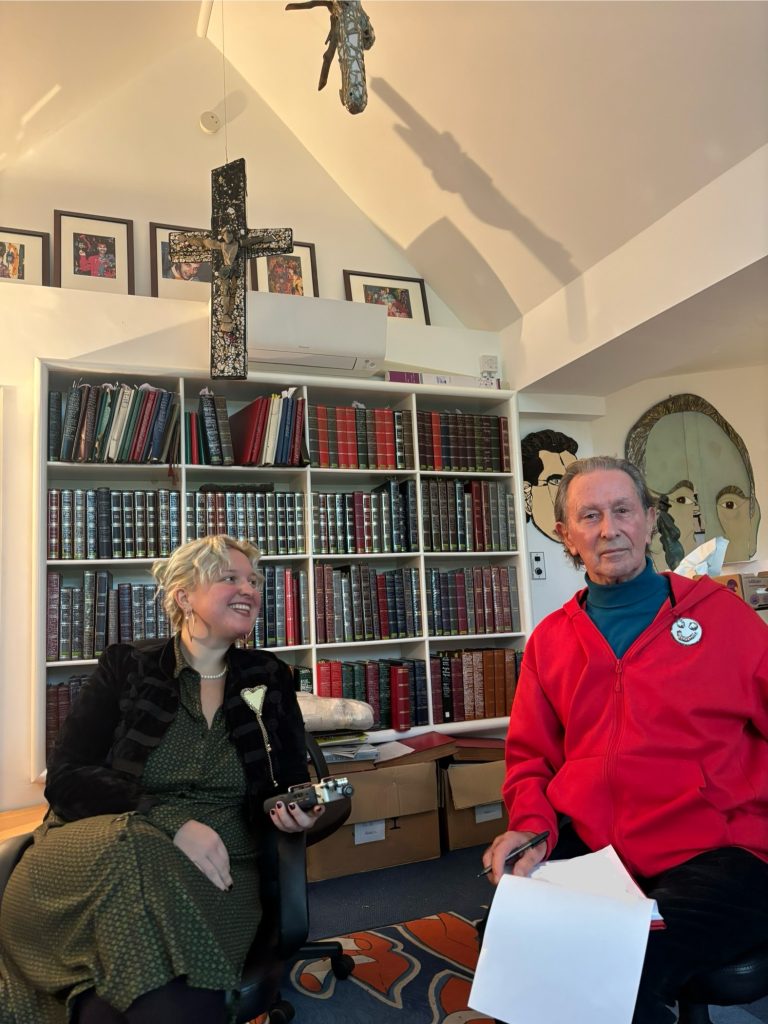
Photo of Sienna Holmes and Michael Davis in October 2025
In October, we had the pleasure of sitting down with Michael Davis, former Chair of Trustees for the Andrew Logan Museum of Sculpture, long-term partner of Andrew, and an irreplaceable part of the museum’s history. What followed was a gentle, generous trip through five decades of their shared life, art, and adventures.
“He just kissed me”: A Beginning in 1971
Michael first met Andrew in 1971 while staying with a friend named Judy Moraes, who was known for inviting what she lovingly called “starving artists” to finish her dinner leftovers. One evening, Andrew was among them.
Michael laughs as he recalls the moment that became legend between them: “He just kissed me.” Unknowingly, the beginning of 55 years together.
Their second meeting was just as serendipitous. Michael spotted Andrew walking through Camden Passage with his mother. He stopped to chat and invited Andrew to his upcoming birthday party on the Barge Raven in Battersea. Years later, Andrew told him that this was “the moment he decided to spend the rest of his life with him.”
It’s a story made all the more remarkable by the era. Same-sex relationships in private had only been decriminalised in 1967, just four years before they met. “We didn’t broadcast that we were living together… it just wasn’t talked about… slightly dangerous,” Michael reflects. And yet, their partnership flourished quietly, creatively, and defiantly.
The Style and Spirit of the 1970s
When asked about the energy of the early 1970s, Michael describes London as alive with a kind of “peacock display”, a buzz of creative tribes and artistic possibility, saying there were only about 200 active artists then in London. Names like Kevin Whitney and Luciana Martinez arose in our conversation, the “golden couple” of their circle that served as a gravitational centre to the scene.
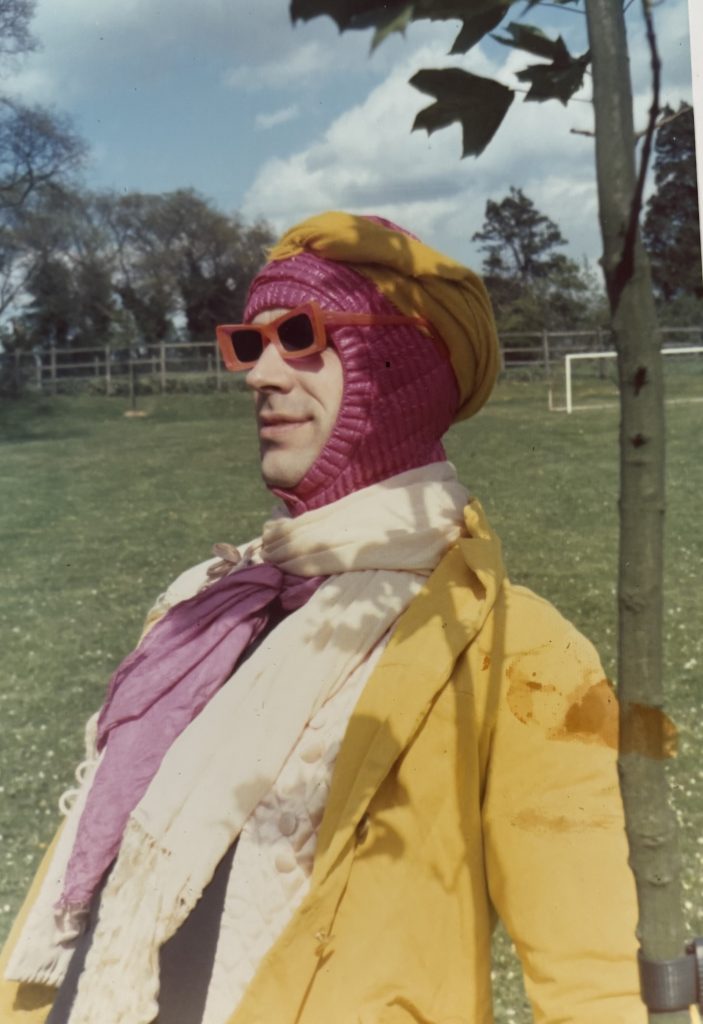
Andrew Logan in 1970’s
At the time, Andrew’s studio was in Downham Road, Hackney, and later from 1975 to 1979 in Butler’s Wharf, overlooking the Thames, St. Katharine Docks and Tower Bridge. Michael and Andrew would make pilgrimages to the Chelsea Flower Show, returning with plants and blooms to fill the warehouse studio – “The Alternative Tower of London” that they were squatting in. Among old photographs in the museum’s archive, the spectacular view from that space still survives.
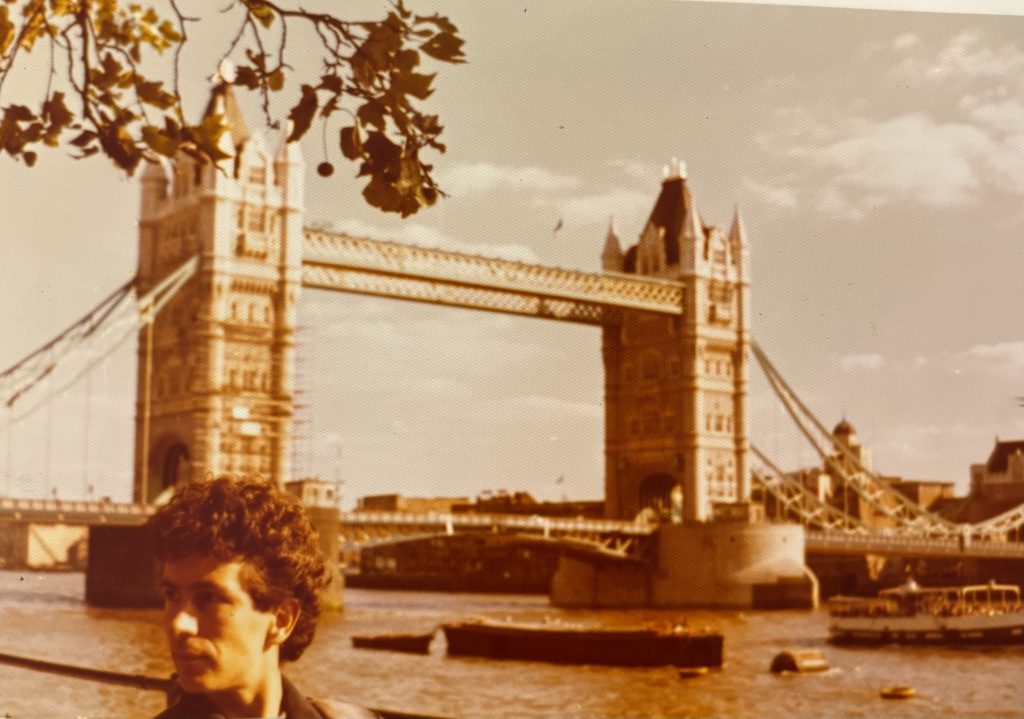
Photos of Michael Davis outsideButler’s Wharf, overlooking the Thames and Tower Bridge 1975
But the most unforgettable memory Michael shares is one almost unbelievable today: A pancake race across Tower Bridge.
In the early 1970s, the bridge was so quiet that Michael, Andrew, and some friends sprinted across it brandishing frying pans and pancakes. Having walked across the same bridge recently, now a river of commuters and tourists, the idea feels surreal.
Those years also brought them into the gravitational pull of a new, rebellious spirit brewing in London. One of the earliest and most emblematic moments was the Sex Pistols’ first official gig, held in Andrew’s studio at their 1976 Valentines Ball.
Michael remembers watching with his hands over his ears: “I liked parts, but I thought, how will I survive this?” The noise level was like being inside a drum.
It was chaotic, raw, and electrifying, and it fed into the sense that they were at the centre of something daring and transformative.
This atmosphere of joyful subversion, theatrical rebellion, and boundary-breaking performance is evidenced by one of Andrew’s own most iconic creations: the Alternative Miss World. A celebration of difference, originality, humour, and self-expression, it grew out of the very same energies that pulsed through their studios, friendships, and nights out. The punk current didn’t just pass through their lives, it helped shape the world they would go on to build.
Why a Museum? “Andrew Makes Things for People to See”
When asked what sparked the idea of founding the Andrew Logan Museum, Michael’s answer is simple: “Andrew makes things for people to see.”
The pair were committed to the idea of a museum not being in London. “Why should everything be in London?” Andrew had said. The building that now houses the glimmering museum in Berriew has its own storied past. Where once cattle sheds had stood, squash courts had been built in the late 1970s. When redundant they became the unlikely but perfect home for Andrew’s work – soaring height with beech sprung floors, in the beautiful village of Berriew.
Michael notes that the word ‘museum’ comes from the Greek for “store house” and a store house was exactly what they needed for the vast collection of sculptures Andrew – ever the prolific maker – was amassing.
In 1986, they visited the former squash courts with a vision of transformation. Little by little, that vision became the dazzling space visitors know today.
Michael also revealed one of the museum’s secrets: the Arum Lily record player, one of the first pieces in the museum’s collection, once featured yellow flowers with green stems. The colours were changed to black and white when the work was moved, so it would sit harmoniously within the village aesthetic of Berriew. These subtle choices, Michael explains, were part of creating a home, not just a gallery, for Andrew’s creations.
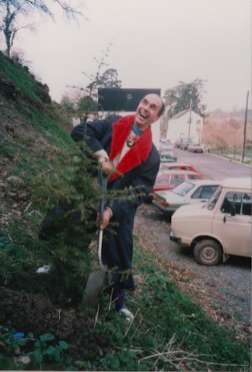
Photo of Andrew in 1988 outside the museum conducting a tree ceremony
Film, Fashion, and Creative Crossroads
Michael also reminisces about his early filmmaking, in the early 1970s, including his early connection with Derek Jarman through Super 8 film screenings he curated at the Architectural Association. Eventually, he stepped away from filmmaking and returned to architecture, a field in which he built a long and respected career.
He speaks fondly of meeting fashion designer and celebrated ‘princess of punk’ Zandra Rhodes in Earl’s Court and helping her disentangle various practical and creative challenges with her house in St. Steven’s Gardens, Notting Hill.
The 1970s also included extraordinary moments in and around Biba, the legendary fashion house department store. Where Andrew created huge fibreglass flowers for the Roof Gardens. Michael recalls the magic of the Biba Roof Gardens and friendships from that era. When the store closed in 1975, the owners, Barbara Hulanicki and Fitz Fitzsimon, famously said: “Go steal something!” At the auction that followed, Andrew and Michael purchased a mock castellated castle from the children’s department, which inspired Andrew’s infamous Alternative Tower of London installation, later becoming the set for Derek Jarman’s film “Sebastiano” and the film “I Want to Be a Beauty Queen” featuring an opening number in the tower sung by Little Nell.
The Birth of a Legacy
Michael reflects on the years of construction, demolition, remodelling, and reinvention that shaped the museum. As he talks, it becomes clear that the museum is not just a building, it’s the physical record of a life lived in colour, craft, and collaboration.
Today, the Andrew Logan Museum stands not only as a storehouse of sculpture, but as a monument to a shared vision: that art should be joyful, accessible, inquisitive, and unafraid of glamour. It preserves the stories that shaped Andrew’s extraordinary career, but also the quieter, profoundly human stories that shaped the life he and Michael built together with their family and friends.
Their memories remind us that the museum is, at its heart, the ongoing celebration of a world they created together.
Cyfweliad gyda Michael – 15 Hydref 2025
Cofio gyda Michael Davis
Dyna bleser ym mis Hydref oedd cael eistedd gyda Michael Davis, cyn Gadeirydd Ymddiriedolwyr Amgueddfa Cerflunwaith Andrew Logan, partner hirdymor Andrew, a rhan anhepgor o hanes yr amgueddfa. Taith dyner, hael trwy bum degawd o’u bywyd, eu celf a’u hanturiaethau ar y cyd oedd yr hyn a ddilynodd.
He just kissed me: Dechreuad ym 1971
Cyfarfu Michael ag Andrew gyntaf ym 1971 wrth iddo aros gyda ffrind o’r enw Judy Moraes, a oedd yn adnabyddus am wahodd y rheiny a alwai yn gariadus yn “artistiaid newynog” i orffen gweddillion ei chinio. Un noson, roedd Andrew yn eu plith.
Mae Michael yn chwerthin wrth iddo gofio’r foment a ddaeth yn chwedl rhyngddynt: He just kissed me. Yn ddiarwybod iddo, dyma ddechrau 55 mlynedd gyda’i gilydd.
Cyfarfod ar hap a damwain wnaethant yr eildro hefyd. Gwelodd Michael Andrew yn cerdded trwy Camden Passage gyda’i fam. Stopiodd i sgwrsio a gwahoddodd Andrew i’w barti pen-blwydd oedd ar ddod ar y Dafarn-fad Raven yn Battersea. Flynyddoedd yn ddiweddarach, dywedodd Andrew wrtho mai dyma oedd “y foment y penderfynodd dreulio weddill ei oes gydag ef.”
Mae’n stori a oedd hyd yn oed yn fwy hynod oherwydd y cyfnod. Dim ond ym 1967 y cafodd statws troseddol perthnasoedd preifat rhwng dau neu ddwy o’r un rhyw ei ddiosg, a hynny gwta bedair blynedd cyn i Michael ac Andrew gyfarfod. “Wnaethon ni ddim dweud wrth bawb ein bod ni’n byw gyda’n gilydd … doedd pobl ddim yn trafod hynny … roedd ychydig yn beryglus,” myfyria Michael. Ac eto, ffynnodd eu partneriaeth yn dawel, yn greadigol, ac yn herfeiddiol.
Arddull ac Ysbryd y 1970au
Pan ofynnwyd iddo am egni dechrau’r 1970au, disgrifiodd Michael ddinas Llundain fel lle bywiog gyda math o “arddangosfa beunod”, yn fwrlwm o lwythau creadigol a phosibiliadau artistig, a dywedodd mai dim ond tua 200 o artistiaid gweithredol oedd yn Llundain bryd hynny. Cododd enwau fel Kevin Whitney a Luciana Martinez yn ein sgwrs. “Pâr euraid” eu cylch a oeddynt, yn ganolbwynt a ddenai bawb i’r sîn.
Ar y pryd, roedd stiwdio Andrew yn Downham Road, Hackney, ac yn ddiweddarach o 1975 i 1979 yn Butler’s Wharf, yn tremio dros afon Tafwys, Dociau St. Katharine a Phont y Tŵr. Byddai Michael ac Andrew yn pererindota gan ymweld â Sioe Flodau Chelsea, a dychwelyd gyda phlanhigion a blodau i lenwi stiwdio’r warws – “Tŵr Amgen Llundain” – yr oeddent yn sgwatio ynddo. Ymhlith hen ffotograffau yn archif yr amgueddfa, mae’r olygfa ysblennydd o’r fan honno yn dal i oroesi.
Ond yr atgof mwyaf bythgofiadwy y mae Michael yn ei rannu â ni yw un sydd bron yn anghredadwy heddiw: ras grempogau dros Bont y Tŵr.
Yn gynnar yn y 1970au, roedd y bont mor dawel nes bod modd i Michael, Andrew, a rhai ffrindiau wibio drosti gyda phadelli ffrio a chrempogau. Wedi i mi gerdded dros yr un bont yn ddiweddar, croesfan sydd bellach yn afon o gymudwyr a thwristiaid, mae’r syniad yn teimlo’n swreal.
Denwyd y ddau yn ystod y cyfnod hwnnw gan ddisgyrchiant ysbryd newydd, gwrthryfelgar a oedd yn dod i’r amlwg yn Llundain. Un o’r eiliadau cynharaf a mwyaf symbolaidd oedd gig swyddogol cyntaf y Sex Pistols, a gynhaliwyd yn stiwdio Andrew yn eu Dawns Dydd San Ffolant ym 1976.
Mae Michael yn cofio gwylio gyda’i ddwylo dros ei glustiau: “Roeddwn i’n hoffi rhannau, ond meddyliais, sut allaf i oroesi hyn?” Roedd lefel y sŵn fel bod y tu mewn i ddrwm!
Roedd yn anhrefnus, yn amrwd, ac yn drydanol, ac fe fwydodd i’r ymdeimlad eu bod yng nghanol rhywbeth beiddgar a thrawsnewidiol.
Roedd yr awyrgylch hwn o danseilio llawen, gwrthryfela theatrig, a pherfformio a oedd yn chwalu ffiniau i’w weld yn amlwg yn un o greadigaethau mwyaf eiconig Andrew ei hun: y Miss World Amgen. Roedd hwn yn ddathliad o wahaniaeth, gwreiddioldeb, hiwmor, a hunanfynegiant, yn gwreiddio o’r un egnïoedd a oedd yn curo trwy eu stiwdios, eu cyfeillgarwch, a’u nosweithiau allan. Nid gwibio trwy eu bywydau a wnaeth y cerrynt pync. Ar y ffordd fe’u helpodd i lunio’r byd y byddent yn mynd ymlaen i’w adeiladu.
Pam Amgueddfa? “Mae Andrew yn Gwneud Pethau i Bobl eu Gweld”
Pan ofynnwyd iddo beth a sbardunodd y syniad o sefydlu Amgueddfa Andrew Logan, mae ateb Michael yn syml: “Mae Andrew yn gwneud pethau i bobl eu gweld.”
Roedd y ddau wedi ymrwymo i’r syniad o amgueddfa heb fod yn Llundain. “Pam y dylai popeth fod yn Llundain?” meddai Andrew. Mae gan yr adeilad sydd bellach yn gartref i’r amgueddfa ddisglair yn Aberriw ei orffennol llawn hanes ei hun. Lle un tro y safai siediau gwartheg, adeiladwyd cyrtiau sboncen ddiwedd y 1970au. A’r rhain bellach yn segur, daethant yn gartref annhebygol ond perffaith i waith Andrew – gyda’u nenfydau uchel a’u lloriau crog o ffawydd, ym mhentref hardd Aberriw.
Mae Michael yn nodi bod y gair ‘Museum’ yn dod o’r Groeg am “storehouose” ac mai storfa yn union yr hyn oedd ei angen arnynt ar gyfer y casgliad helaeth o gerfluniau yr oedd Andrew – a fu’n wneuthurwr toreithiog erioed – yn eu casglu.
Ym 1986, ymwelsant â’r cyn-gyrtiau sboncen gyda gweledigaeth o’u trawsnewid. Fesul tipyn, daeth y weledigaeth honno’n ofod llachar y mae ymwelwyr yn ei adnabod heddiw.
Datgelodd Michael hefyd un o gyfrinachau’r amgueddfa: ar un adeg, roedd gan chwaraewr recordiau siâp Lili’r Grog, un o’r darnau cyntaf yng nghasgliad yr amgueddfa, flodau melyn gyda choesynnau gwyrdd. Newidiwyd y lliwiau i ddu a gwyn pan symudwyd y gwaith, fel y byddai’n eistedd yn cyd-fynd ag estheteg pentref Aberriw. Roedd y dewisiadau cynnil hyn, eglura Michael, yn rhan o greu cartref, ac nid oriel yn unig, ar gyfer creadigaethau Andrew.
Ffilm, Ffasiwn, a Chroesffyrdd Creadigol
Mae Michael hefyd yn hel atgofion am ei gyfnod cynnar yn gwneud ffilmiau, yn gynnar yn y 1970au, gan gynnwys ei gysylltiad cynnar â Derek Jarman drwy ddangosiadau ffilm Super 8 a guradodd yn y Gymdeithas Bensaernïol. Yn y pen draw, rhoddodd y gorau i wneud ffilmiau a dychwelodd i faes pensaernïaeth, lle adeiladodd yrfa hir a pharchus.
Mae’n siarad yn hoffus am gyfarfod â’r dylunydd ffasiwn a’r ‘dywysoges bync’ enwog Zandra Rhodes yn Earl’s Court ac am ei ymdrechion i ddatrys heriau ymarferol a chreadigol amrywiol ei thŷ yng St. Steven’s Gardens, Notting Hill.
Roedd y 1970au hefyd yn cynnwys eiliadau rhyfeddol yn Biba a’r cyffiniau. Siop adrannol tŷ ffasiwn rhyfeddol oedd hon lle creodd Andrew flodau ffibr gwydr enfawr ar gyfer Gerddi’r To. Mae Michael yn cofio hud Gerddi To Biba ac aml i gyfeillgarwch o’r cyfnod hwnnw. Pan gaeodd y siop ym 1975, dywedodd y perchnogion, Barbara Hulanicki a Fitz Fitzsimon: “Go steal something!” Yn yr ocsiwn a ddilynodd, prynodd Andrew a Michael gastell castellog ffug o adran y plant, a ysbrydolodd Andrew wrth iddo greu ei osodiad enwog Tŵr Amgen Llundain, a ddaeth yn set yn ddiweddarach ar gyfer ffilm Derek Jarman “Sebastiano” a’r ffilm “I Want to Be a Beauty Queen” gyda’r gân agoriadol yn y tŵr yn cael ei chanu gan Little Nell.
Genedigaeth Etifeddiaeth
Mae Michael yn myfyrio ar y blynyddoedd o adeiladu, dymchwel, ailfodelu ac ailddyfeisio a luniodd yr amgueddfa. Wrth iddo siarad, daw’n amlwg nad adeilad yn unig yw’r amgueddfa, mae’n gofnod ffisegol o fywyd sy’n cael ei fyw mewn lliw, crefft a chydweithio.
Heddiw, saif Amgueddfa Andrew Logan nid yn unig fel storfa gerfluniau, ond fel cofeb i weledigaeth a rennir: sef y syniad y dylai celf fod yn llawen, yn hygyrch, yn chwilfrydig, ac na ddylai ofni cyfaredd. Mae’n cadw’r straeon a luniodd yrfa ryfeddol Andrew, ond hefyd y straeon tawelach, dynol a dwfn a luniodd y bywyd a adeiladodd ef a Michael gyda’i gilydd â’u teulu a’u ffrindiau. Mae atgofion y ddau yn ein hatgoffa ni mai dathliad parhaus o fyd a greon nhw gyda’i gilydd yw’r amgueddfa yn ei hanfod.

10 months ago